Jenny McGiven
Aldeburgh resident and keen rambler
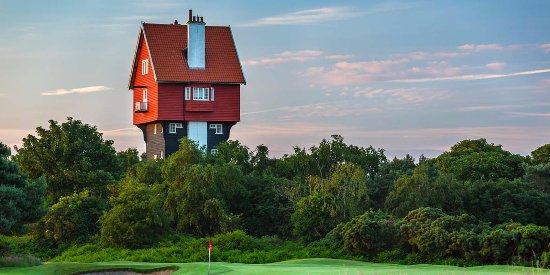
If you’ve ever found yourself standing on the shingle at Aldeburgh, staring north towards that little cluster of buildings in the distance, you’ve probably felt the pull. It’s a walk that seems to call out to everyone who visits this part of the Suffolk coast. You might have heard whispers about a “fairytale village” or seen postcards of a house that looks like it’s floating above the trees.
Well, you’re in for a treat. The walk from Aldeburgh to Thorpeness isn’t just a stroll along the beach; it’s a journey between two completely different worlds. You start in a historic fishing town that feels very real and grounded, and you end up in a place that was quite literally built as a fantasy.
For anyone staying in the area, this is hands-down one of the best ways to spend a morning or afternoon. It’s easy on the legs, full of history, and finishes with a pint or a cream tea. What’s not to love?
In this guide, we’re going to walk you through every step of the aldeburgh to thorpeness walk, tell you the secrets of the famous House in the Clouds, and help you find the best spots to grab a bite when you get there. Grab your walking boots (or just sturdy trainers), and let’s get going.
Starting Point: Fort Green and The Chips Debate
Most people kick off their walk at the Fort Green car park at the southern end of Aldeburgh High Street. It’s a great spot to get your bearings. To your right, you have the North Sea, usually doing its best to be dramatic. To your left, the town stretches out with its pastel-coloured holiday cottages and the smell of salt and vinegar in the air.
Speaking of salt and vinegar, we can’t talk about walking in Aldeburgh without mentioning the fish and chips. If you’re starting this walk around lunchtime, you’ll see the legendary queues winding down the street from the Aldeburgh Fish and Chip Shop or the Golden Galleon. You might want to fuel up before you go, but fair warning: eating a large cod and chips before a three-mile walk requires a certain level of dedication!
As you head north along the sea wall, leaving the Martello Tower behind you, the town starts to thin out. This stretch of the path—the Crag Path—is perfect for people-watching. You’ll see locals walking their dogs, day-trippers clutching ice creams, and fishermen selling their fresh catch from the little black huts on the beach. It’s a scene that hasn’t changed much in decades.
The Scallop: A Marmite Masterpiece
About a mile or so along the beach, just as the buildings start to give way to scrub and shingle, you’ll come across something that stops most people in their tracks. It’s huge, it’s metal, and it’s arguably the most talked-about object on the entire Suffolk coast.
This is The Scallop.
For those searching for the maggi hambling scallop sculpture location, you can’t miss it—it’s right on the beach, just north of the town centre, standing about 15 feet tall. Created by local artist Maggi Hambling and unveiled in 2003, it’s a tribute to the composer Benjamin Britten, who lived in Aldeburgh and spent hours walking this very stretch of coast.
If you get up close, you’ll see words pierced into the steel rim: “I hear those voices that will not be drowned.” It’s a line from Britten’s opera, Peter Grimes.
Here’s the thing about The Scallop: people either love it or they really, really don’t. Some folks say it ruins the unspoilt view of the beach. Others think it’s a powerful piece of art that captures the wild spirit of the sea. It’s a bit of a local “Marmite” situation. But whatever your take, it’s a brilliant photo opportunity. The steel surface changes colour depending on the sky—sometimes it’s a bright, gleaming silver, other times a moody, rusted brown.
And yes, you are allowed to sit on it. In fact, that was Hambling’s intention—for people to sit and watch the waves. So, take a moment, have a sit, and decide which side of the debate you’re on.
The Walk North: Shingle, Sky, and Sizewell
Once you leave The Scallop behind, the aldeburgh to thorpeness walk really changes gear. The paved path eventually runs out, and you have a choice. You can slog it out on the shingle beach itself (great for the calves, hard work for everything else), or you can hop onto the dirt path that runs parallel to the beach, just behind the ridge.
This is where the Suffolk coast feels most like itself. It’s wild, windswept, and incredibly open. To your left, you have the marshes and the reedy beds of the North Warren nature reserve. Keep an eye out for marsh harriers—they’re often seen quartering over the reeds looking for lunch.
To your right, the sea is your constant companion. But if you look straight ahead, you’ll see a strange contrast that defines this part of the world. In the distance, the white dome of the Sizewell B nuclear power station sits on the horizon like a giant golf ball. It’s a stark piece of brutalist architecture against the soft, natural landscape. It’s a reminder that this coast is a working place, not just a postcard.
As you get closer to Thorpeness, you’ll start to notice the buildings changing. The classic Victorian architecture of Aldeburgh fades away, replaced by something… different. The houses start to look a bit odd. A bit quirky. That’s your first sign that you’re entering the “fantasy village.”
Arriving in Thorpeness: The Village That Never Was
Walking into Thorpeness from the beach is a bit like stepping through a wardrobe into Narnia. One minute you’re on a rugged English beach; the next, you’re in a village that looks like it was designed by someone who had read too many fairytales.
And actually, that’s not far from the truth.
Thorpeness isn’t like other villages. It didn’t grow organically over hundreds of years. It was built almost entirely in the 1910s and 20s by a wealthy Scottish barrister named Glencairn Stuart Ogilvie. He bought the land (which was just a tiny fishing hamlet called Thorpe back then) and decided to turn it into a private holiday village for his friends and family.
But Ogilvie didn’t want a standard seaside resort. He hated the idea of promenades and piers. He wanted to create a rustic, “olde worlde” escape—a place where people could live a simple, healthy life. He called it a “Garden Village.”
As you walk in from the beach, notice the architecture. It’s a mix of Mock Tudor, Jacobean, and just plain whimsical. The roads aren’t paved with tarmac; they’re sandy tracks. There are no streetlights. It feels frozen in time, somewhere around 1925.
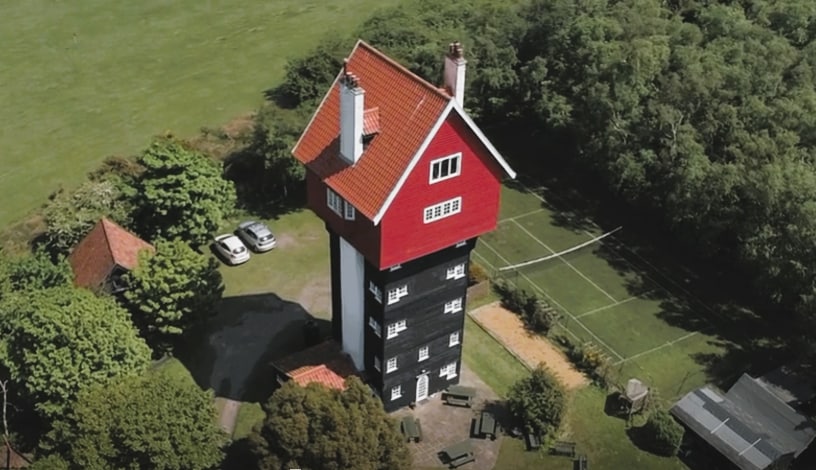
The House in the Clouds: A Suffolk Icon
Now, let’s talk about the big one. The landmark you’ve probably been spotting all the way from Aldeburgh. As you head inland from the beach past the wonderfully named “Dolphin Inn,” look up. You can’t miss it.
The house in the clouds history is one of the best stories in the village. When Ogilvie was building Thorpeness, he had a problem. He needed a water tower to supply the village, but he thought water towers were ugly. They were big, industrial eyesores that would ruin his perfect fantasy aesthetic.
So, he did something brilliant. He disguised it.
In 1923, the water tower was built, but instead of leaving it as a steel tank on legs, Ogilvie had it clad in wood to look like a house perched on top of the trees. The “house” at the top was originally just a shell to hide the water tank (which held 50,000 gallons!).
It wasn’t just a disguise, though. The name “House in the Clouds” was given to it by Mrs. Malcolm Mason, a children’s author and friend of the Ogilvies. It fits perfectly, doesn’t it?
The story gets even better. In 1979, the village was connected to the mains water supply, so the water tower wasn’t needed anymore. The tank was removed, and that space at the very top—the “room at the top”—was converted into a massive living space.
Today, the House in the Clouds is a holiday rental. It has five bedrooms, three bathrooms, and 67 stairs to get to the top. It’s one of the most famous follies in the UK. If you’re lucky enough to stay there, the views are incredible—you can see all the way to the lighthouse at Orford Ness on a clear day. For the rest of us on the ground, it remains a magical photo op and a testament to one man’s refusal to let a water tank ruin his view.
Right next to the House in the Clouds, you’ll see a windmill. This is the Thorpeness Windmill, and it’s not just for show either. It was originally built in a nearby village in 1803 and was moved here by Ogilvie to pump water up into the House in the Clouds. Talk about commitment to a theme!
The Meare: Peter Pan’s Playground
If the House in the Clouds is the head of Thorpeness, The Meare is its heart.
Just a short walk from the beach is this beautiful, man-made boating lake. But again, in true Thorpeness style, it’s not just a lake. It’s a playground.
Ogilvie was a friend of J.M. Barrie, the author of Peter Pan. When he dug out The Meare (which was done by hand, by the way), he designed the islands and channels to reflect the story of the Boy Who Wouldn’t Grow Up.
As you walk around the edge, you’ll see little islands with names like “The Pirate’s Lair,” “Wendy’s House,” and “Captain’s House.” There’s even a crocodile hidden somewhere in the water (don’t worry, it’s plastic).
If you’re visiting in the spring or summer, checking the thorpeness boating lake opening times is a must. Generally, The Meare opens for the season around late March or Easter and stays open until late October. It’s usually open from roughly 8:30 am to 5:00 pm, but this can change with the weather—after all, it’s an outdoor activity.
The best thing about The Meare? It’s incredibly shallow. Ogilvie designed it so that it’s rarely more than three feet deep. The idea was that children could learn to row and sail safely. If you fall in, you just stand up (though you will be very muddy).
You can hire rowing boats, kayaks, punts, and sailing boats from the boathouse. It’s a chaotic, joyful scene on a sunny day, with families bumping into each other in rowing boats and kids storming the “fort” on the islands. It’s pure, old-fashioned fun.
Refuelling: Where to Eat and Drink
By now, you’ve walked a good few miles, and you’ve soaked up a lot of history. You probably need a drink.
Thorpeness has a few great spots. The main hub is The Dolphin Inn. It’s located right in the middle of the village, and it’s a lovely place. It has a big beer garden which is perfect for summer, and a cosy interior for those brisk winter days. The food is excellent—think upmarket pub grub with plenty of local Suffolk produce. It’s also very dog-friendly, which is good news if you’ve brought a four-legged friend on the walk.
If you’re after something lighter, head to The Kitchen @ Thorpeness. It’s a café right near the Meare. They do fantastic coffee, homemade cakes, and light lunches. It’s a great spot to sit outside and watch the boats go by.
There’s also a little tea room right on the Meare side of the water, which is perfect for an ice cream stop.
The Return Journey: Beach or Track?
So, you’ve seen the House in the Clouds, you’ve waved at the ducks on the Meare, and you’ve had a pint at The Dolphin. Now you have to get back to Aldeburgh.
You have two main options:
1. The Beach (The Way You Came)
You can simply turn around and walk back along the coastal path. The view is different walking south—you get a great view of the Aldeburgh skyline and the Martello Tower growing larger as you approach. It’s simple, impossible to get lost, and keeps you by the sea.
2. The Old Railway Line (The Circular Route)
If you want a change of scenery, you can make this a circular walk. Head away from the sea, past the golf course, and pick up the path that follows the route of the old railway line.
The railway used to run all the way to Aldeburgh station (which is now a pub called The Railway—funny that), but it closed in the 1960s. The trackbed is now a fantastic, flat walking path. It’s more sheltered than the beach, which is a blessing on a windy day. It takes you through woodland and scrub, full of gorse and butterflies in the summer.
This path eventually spits you out near the roundabout at the entrance to Aldeburgh. From there, it’s a short walk back to the High Street or the river wall if you want to see the River Alde.

Why This Walk Matters
It’s easy to get caught up in the “must-dos” of a holiday. But the walk from Aldeburgh to Thorpeness is special because it slows you down. It forces you to look at the landscape, to notice the transition from the real world to Ogilvie’s fantasy world.
It’s a walk of contrasts. You have the ancient, shifting shingle beach against the permanent steel of the Scallop. You have the humble fishing huts of Aldeburgh against the eccentric grandeur of the House in the Clouds. You have the serious business of the nuclear power station against the playful innocence of the Peter Pan islands.
It captures everything that makes this little corner of Suffolk so unique. It’s eccentric, it’s beautiful, and it doesn’t take itself too seriously.
So, next time you’re in Aldeburgh, don’t just stay in the town. Look north. There’s a house in the clouds waiting for you.
Quick Guide for Visitors
Distance: Approx 2.5 miles (one way)
Time: Allow 45 mins to 1 hour (one way), but give yourself half a day to explore Thorpeness.
Difficulty: Easy. Flat terrain, though walking on loose shingle can be tiring if you stray off the path.
Parking: Fort Green Car Park, Aldeburgh (IP15 5DE).
Key Stops: The Scallop, The Dolphin Inn, Thorpeness Meare, House in the Clouds.
(Note for visitors: Please check local listings for the most up-to-date opening times for businesses mentioned, as seasonal hours can apply in Suffolk!)